
How is skin pigmentation and your mitochondria inside your cells connected
Part 2 of our Mitochondria Series
This article builds on the foundations introduced in Part 1: What Are Mitochondria, and Why Do They Run Everything? Full access to the complete series is available to Sunshine Community members.
Why skin needs so much energy
If mitochondria are the engines running your brain, your metabolism, and your resilience to stress, it should come as no surprise that they're just as central to how your skin looks and ages.
Skin is one of the most energy-demanding organs in the body. It's constantly renewing itself, defending against environmental stress, and repairing damage, and nearly every process tied to youthful, healthy-looking skin depends on well-functioning mitochondria:
- ATP production to fuel cell repair and renewal
- Collagen and elastin synthesis by fibroblasts
- Barrier repair after UV exposure
- Wound healing
- Control of oxidative stress
- Regulation of inflammation
- Melanin production and distribution
That last item, melanin production, is one of the most energy-intensive jobs skin cells carry out. Making pigment takes real cellular fuel, which means mitochondria act almost like gatekeepers, deciding how much melanin gets made and when.
Mitochondria and pigmentation
Melanocytes, the cells responsible for producing melanin, are packed with mitochondria, and they seem to run on their own internal clock. Fibroblasts and pigment-producing cells appear to follow a daily rhythm, ramping up melanin production during daylight UV exposure and easing off at night, timing that matches the skin's natural sun-protection response to actual need.
Modern habits can throw that rhythm off. Poor sleep, limited time outdoors, and near-constant sunglasses use may interfere with the light signalling that keeps this internal clock accurate. Sunlight (both UV and blue light reaching the eyes) functions as a genuine input signal to the brain-skin connection, helping regulate melanin production. Removing that signal entirely doesn't necessarily protect skin; it may simply leave it less prepared for the sun exposure it eventually receives.
When mitochondrial function declines or this signalling gets disrupted, a few things tend to follow:
- Increased reactive oxygen species (ROS)
- Oxidative stress within melanocytes
- Altered melanin production
- Uneven pigment distribution
- A greater likelihood of age spots and post-inflammatory hyperpigmentation
There's growing evidence linking mitochondrial dysfunction to pigmentation disorders like melasma and vitiligo, alongside the more familiar contributors of UV exposure, hormones, and inflammation. It's a gentle challenge to the old "sun is the enemy" narrative: pigmentation issues may often be less about sun exposure alone, and more a broader signal of internal cellular stress and mitochondrial strain.
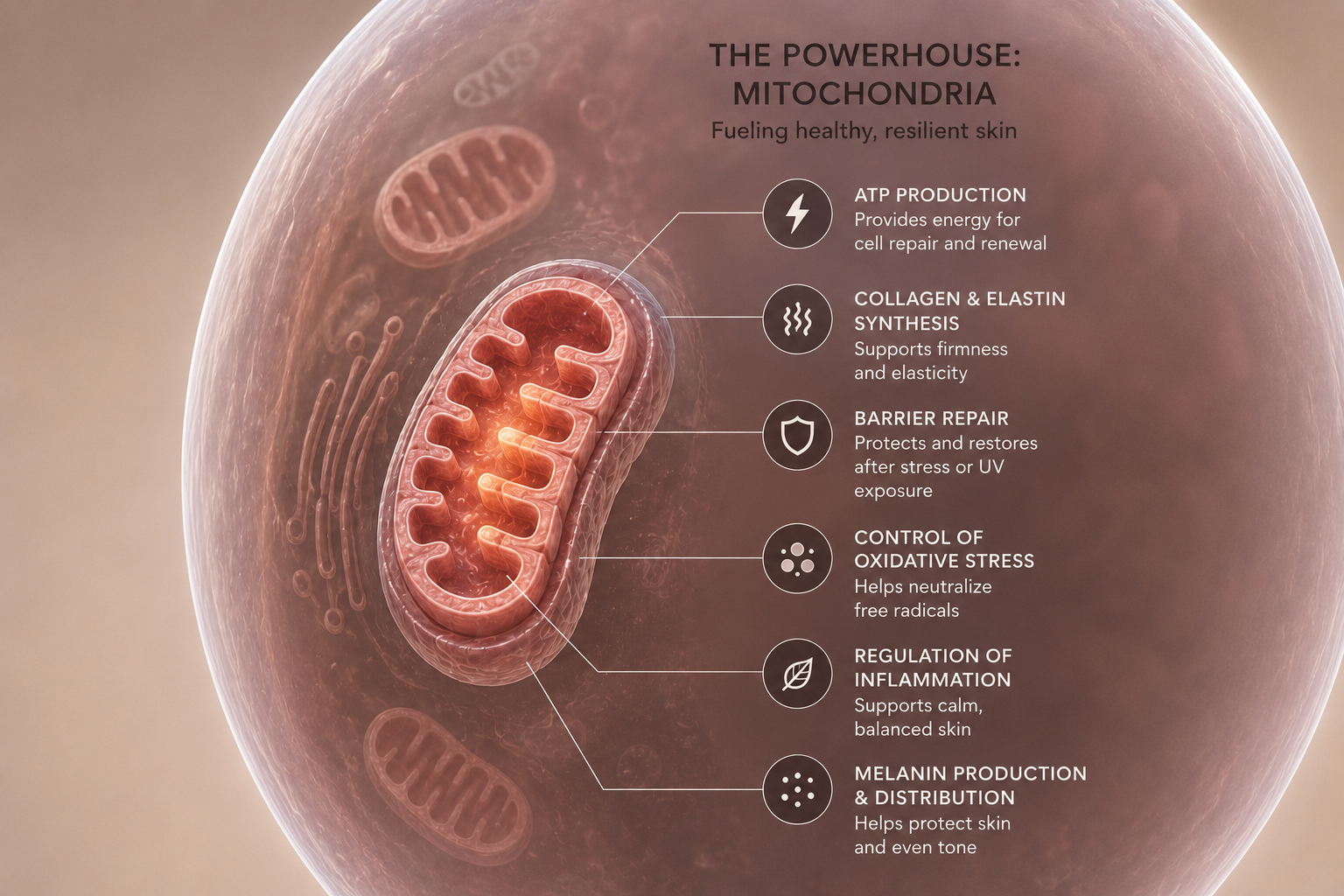
Beautiful skin isn’t just about what you put on it. Every day, your mitochondria quietly power the processes that keep your skin strong, resilient, and able to repair, protect, and renew itself.
Disclaimer:
We do not recommend taking supplements without first consulting a qualified healthcare professional. If you are experiencing pigmentation concerns, we also encourage you to seek guidance from a qualified Holistic Skin Therapist. The information provided here is intended for educational and inspirational purposes only and should not be considered medical advice.
Both Holistic Health Coaches and Holistic Skin Therapists can be found in the Practitioners category within the Sunshine Community.
Continue the Mitochondria Series inside Sunshine Community
This is Part 2 of our three-part guide to mitochondrial health. Members can explore Part 1, continue reading this article, and unlock Part 3, where we share our favourite lifestyle habits, nutrients, and supplements for supporting healthy mitochondria.
Sources
- Raichle, M. E., & Gusnard, D. A. (2002). Appraising the brain's energy budget. PNAS.
- Wallace, D. C. (2005). A mitochondrial paradigm of metabolic and degenerative diseases, aging, and cancer: a dawn for evolutionary medicine. Annual Review of Genetics.
- Naviaux, R. K. (2020). Perspective: Cell danger response biology, the new science that connects environmental health with mitochondria and the rising tide of chronic illness. Mitochondrion.
- Andreux, P. A., et al. (2019). This first-in-human trial reported that urolithin A is well tolerated and bioavailable after oral administration, and provided clinical data indicating it may improve mitochondrial and cellular health in human muscle. Published in Nature Metabolism:
- https://www.pnas.org/doi/full/10.1073/pnas.0710766105%20
- https://pmc.ncbi.nlm.nih.gov/articles/PMC2821041/
- https://pubmed.ncbi.nlm.nih.gov/31877376
- http://pubmed.ncbi.nlm.nih.gov/30742092
- http://pubmed.ncbi.nlm.nih.gov/35584623