Sunny side up: a guide to living with plastic
Plastic isn't the villain of this story, but the way we use it has gotten out of hand, and the place it matters most is where it touches our food.
Look around any kitchen and the plastic is everywhere: blenders, food processor bowls, mixing bowls, spatulas, cups, pitchers, cutlery, strainers and takeaway tumblers. Add the popular habit of weekend meal prep, with rows of neat containers filled with vegetable, fruit, protein and berries, and it's easy to see how much of what we eat spends time in plastic.
There's a good reason for that. Plastic has made lives easier and cheaper. It is versatile, light, waterproof, durable and inexpensive. The point of this guide is not to fear plastic or throw everything away immediately. It's to understand which plastics behave well, which don't, and how to make a few easy swaps that keep your meals fresh and your kitchen a little less toxic and cleaner.
A useful place to start is what plastic actually is. Every plastic is a long string of polymers combined with a mix of added chemicals. The exact "recipes" are proprietary, so manufacturers don't have to tell us what's in them. That's one reason it pays to know the basics of the numbering system below.
Meet the plastic family: what the numbers mean
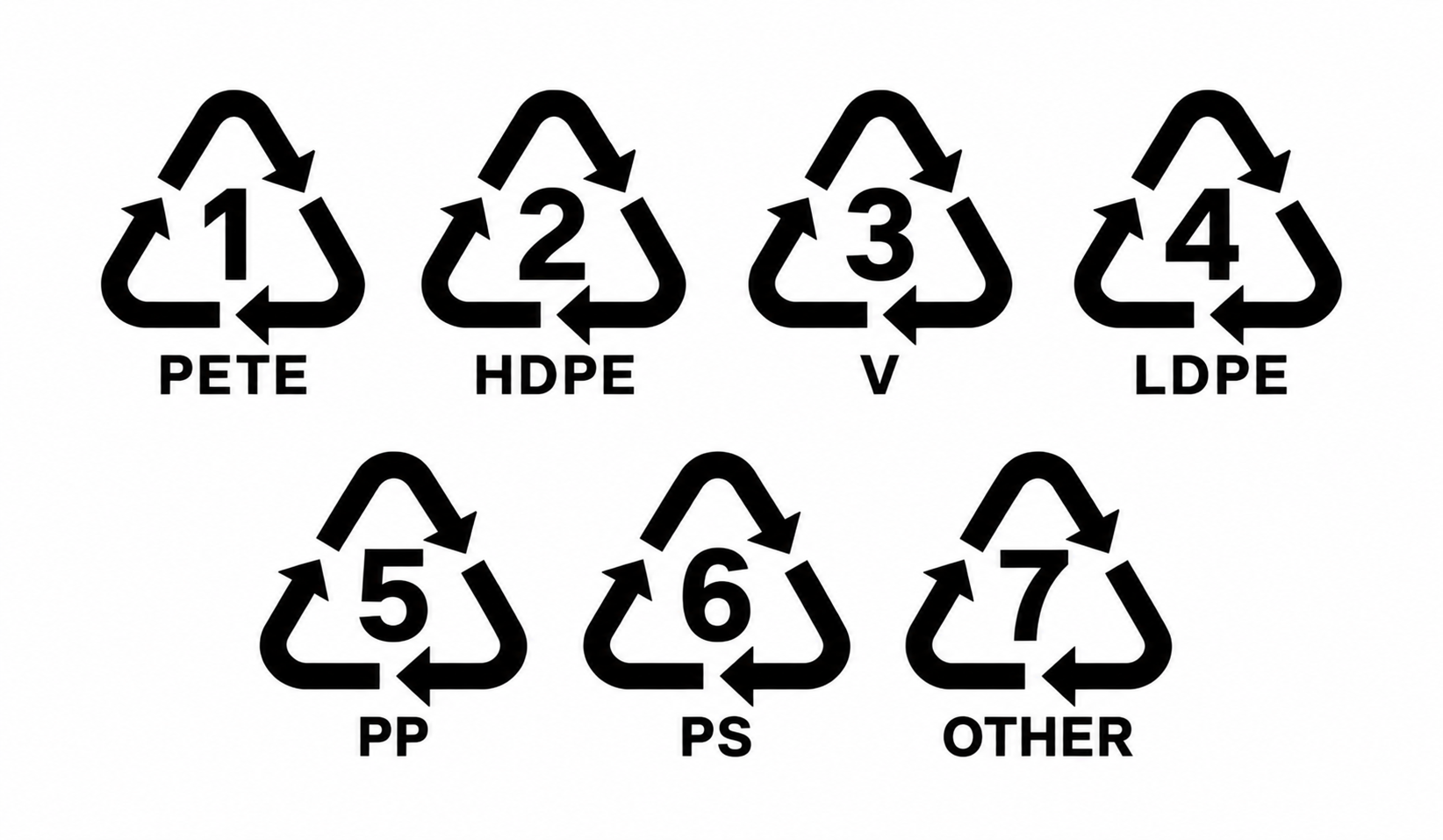
Have you ever seen the little triangle at the bottom of a plastic juice bottle or on plastic packaging? See the image below. The recycling triangle on the bottom of a product holds a number from 1 to 7. It's a resin identification code, and it tells you which type of plastic you're holding. Once you can read it, you can make smarter and better choices in seconds. The short version: 5, 4 and 2 are the friendlier numbers for food, and the rest are best kept away from what you eat and drink.
1. PET (polyethylene terephthalate)
PET is the most commonly used plastic. It's the thin, clear plastic in water bottles and in bottles of juice, peanut butter and ketchup. In textiles the same plastic is called polyester.
Know your plastics
Inside Sunshine Community, we break down all seven plastic types, share the simple 5, 4 and 2 rule to remember when shopping, and explore BPA, silicone and practical ways to reduce plastic around food without trying to make your kitchen perfectly plastic-free.
Sources
- Bittner, G. D., Yang, C. Z., & Stoner, M. A. (2014). Estrogenic chemicals often leach from BPA-free plastic products that are replacements for BPA-containing polycarbonate products. Environmental Health, 13, 41.
- European Chemicals Agency (ECHA). Bisphenols.
- E&E News. (2022). FDA agrees to reassess BPA risks.
- European Food Safety Authority (EFSA). (2021). Bisphenol A: EFSA draft opinion proposes lowering the tolerable daily intake.
- Good Housekeeping. (2022). Exactly What Every Plastic Recycling Symbol Really Means.
- Pupo, M., Pisano, A., Lappano, R., Santolla, M. F., De Francesco, E. M., Abonante, S., Rosano, C., & Maggiolini, M. (2012). Bisphenol A induces gene expression changes and proliferative effects through GPER in breast cancer cells and cancer-associated fibroblasts. Environmental Health Perspectives, 120(8), 1177–1182.
- Rudel, R. A., Gray, J. M., Engel, C. L., Rawsthorne, T. W., Dodson, R. E., Ackerman, J. M., Rizzo, J., Nudelman, J. L., & Brody, J. G. (2011). Food packaging and bisphenol A and bis(2-ethylhexyl) phthalate exposure: Findings from a dietary intervention. Environmental Health Perspectives, 119(7), 914–920.
- National Institute of Environmental Health Sciences (NIEHS). Bisphenol A (BPA).
Urinary, circulating, and tissue biomonitoring studies indicate widespread exposure to bisphenol A. Reproductive Toxicology. PubMed
- Texas A&M AgriLife. (2018). Study Shows BPA a Risk Factor for Inflammatory Bowel Disease.
- Bisphenol S and F: A systematic review and comparison of the hormonal activity of bisphenol A substitutes. Environmental Health Perspectives (2015).
- The Endocrine Society. (2016). BPA Substitute Can Trigger Fat Cell Formation.
- Study on the leaching of phthalates from polyethylene terephthalate bottles into mineral water. Science of the Total Environment.
- Screening of estrogen-like activity of mineral water stored in PET bottles. International Journal of Hygiene and Environmental Health.
- Migration of Nonylphenol from Plastic Containers to Water and a Milk Surrogate. Journal of Agricultural and Food Chemistry.
- Toxic-Free Future. PVC Poison Plastic: Vinyl Chloride and Toxic Waste.
- International Agency for Research on Cancer (IARC). Styrene — Group 2B classification overview.
- Silicone bakeware as a source of human exposure to cyclic siloxanes via inhalation and baked food consumption. Food and Chemical Toxicology (2025).