The truth about synthetic home fragrance
What’s really inside “fragrance”?
Here's the part that surprised me most: the word "fragrance" on an ingredient label isn't one ingredient at all. It's a catch-all term that can stand in for a mix of dozens of different chemical compounds, none of which the manufacturer is required to name individually.
That's because fragrance formulas are generally protected as trade secrets, so companies aren't obligated to spell out exactly what's in the blend. In practice, that means a person can read a label front to back and still have no real idea what they're breathing in or absorbing through their skin.
If you're thinking about hormone health, pregnancy, fertility, or just general toxin exposure, that lack of transparency is worth pausing on, especially for something used daily and repeatedly throughout the house.
A few specific compounds that often turn up in fragrance blends are worth knowing about:
Phthalates
are used as solvents and stabilizers to help scent last longer, and they show up everywhere from cosmetics and perfumes to air fresheners and even food packaging. They're well-established endocrine disruptors, meaning they can interfere with hormone signalling. While the body metabolizes phthalates fairly quickly, exposure is so frequent and widespread that the internal presence ends up being near constant. Research has linked phthalate exposure to issues including preterm birth, early puberty in children, reduced sperm quality, and asthma.
Styrene
sometimes used to help stabilize scent, has been classified as possibly carcinogenic to humans by the International Agency for Research on Cancer. It's most concerning through inhalation, which is exactly how we're exposed to it through candles, sprays, and air fresheners. Chronic exposure has also been associated with fatigue, central nervous system effects, and hearing loss.
Parabens
common preservatives in fragranced products, have demonstrated estrogenic activity, meaning they can bind to estrogen receptors and mimic estrogen in the body. Several have been flagged as endocrine disruptors in research.
None of this means scent itself is a problem; it's the not knowing, plus the daily pileup from shampoo, lotion, deodorant, detergent, candles, and sprays, that adds up over time into ongoing low-dose chemical exposure.
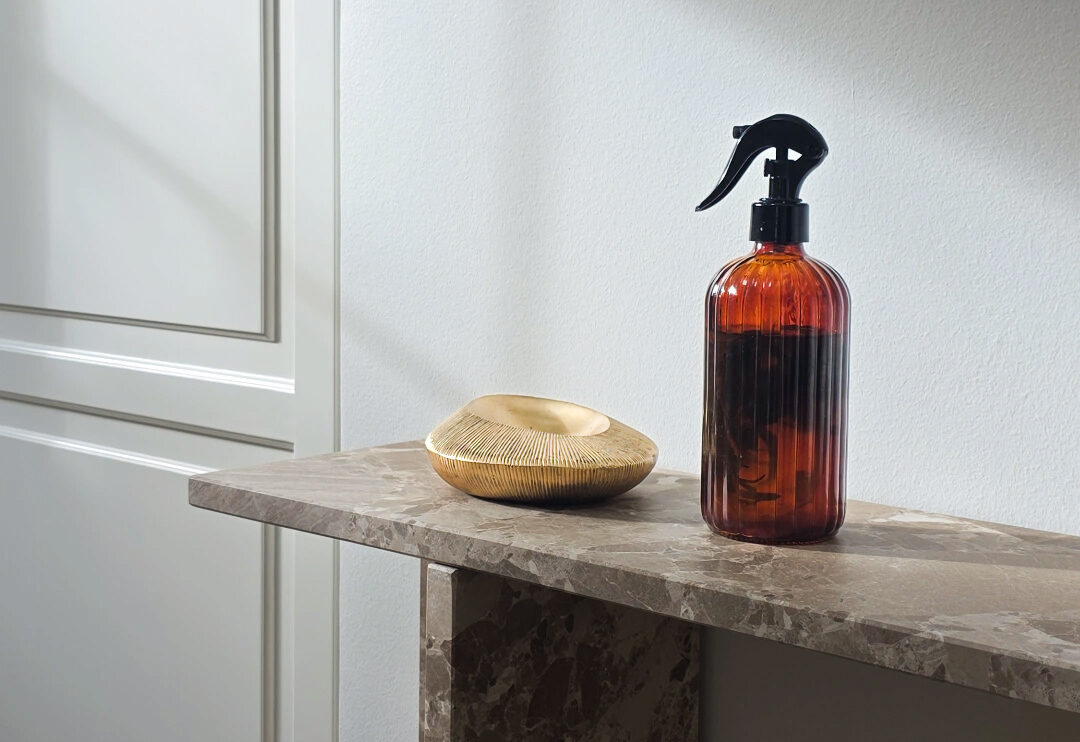
If you want to start identifying these ingredients yourself, look for anything ending in "-phthalate" (like diethyl phthalate, or DEP) or "-paraben" (like methylparaben or butylparaben) on a label. You can also seek out brands that fully disclose their fragrance ingredients or carry third-party certifications, which require full ingredient disclosure as part of the evaluation process.
The reassuring part is that you don't need any of it. A bottle of filtered water and a few natural ingredients can freshen a room just as well.
Read the full article
Inside the Sunshine Community you’ll find the full article, including two favourite natural room spray recipes, seasonal variations, and a few simple swaps to help create a fresher home without relying on synthetic fragrance.
Sources
- [1] Boor, B. E., Jarnstrom, H., Novoselac, A., & Xu, Y. (2014, March). Exposure to Emissions of Volatile Organic Compounds From Crib Mattresses. National Library of Medicine.
- [2] Meeker, J. D., Johnson, P. I., Camann, D., & Hauser, R. (2009, May 1). Polybrominated diphenyl ether (PBDE) concentrations in house dust are related to hormone levels in men. ScienceDirect.
- [3] Patisaul, H. B., Roberts, S. C., Mabrey, N., McCaffrey, K. A., Gear, R. B., Braun, J., Belcher, S. M., & Stapleton, H. M. (2012, November 8). Accumulation and Endocrine Disrupting Effects of the Flame Retardant Mixture Firemaster 550 in Rats: An Exploratory Assessment. Wiley Online Library.
- [4] Eskenazi, B., Chevrier, J., Rauch, S. A., Kogut, K., Harley, K. G., Johnson, C., Trujillo, C., Sjodin, A., & Bradman, A. (2013, February). In utero and childhood polybrominated diphenyl ether (PBDE) exposures and neurodevelopment in the CHAMACOS study. National Library of Medicine.
- [5] Roze, E., Meijer, L., Bakker, A., Van Braeckel, K. N., Sauer, P. J., & Bos, A. F. (2009, August). Prenatal exposure to organohalogens, including brominated flame retardants, influences motor, cognitive and behavioral performance at school age. Europe PMC.
[6] Springer, C., Dere, E., Hall, S. J., McDonnell, E. V., Roberts, S. C., Butt, C. M., Stapleton, H. M., Watkins, D. J., McClean, M. D., Webster, T. F., Schlezinger, J. J., & Boekelheide, K. (2012, December). Rodent Thyroid, Liver, and Fetal Testis Toxicity of the Monoester Metabolites of Bis-(2-ethylhexyl) Tetrabromophthalate (TBPH), a Novel Brominated Flame Retardant Present in Indoor Dust. National Library of Medicine.